

If you have a missing tooth or a denture that slips, dental implants can help you smile, speak, and chew with confidence again. An implant replacement looks and feels like a natural tooth. It’s strong, stable, and built to last.
Dr. Eric Gartner provides results that look natural and feel solid. Visit our restorative dentistry in Wayne, PA, for all your implant restoration needs. Learn how Strafford Dental can restore your missing teeth, the benefits of this popular restoration, and more.
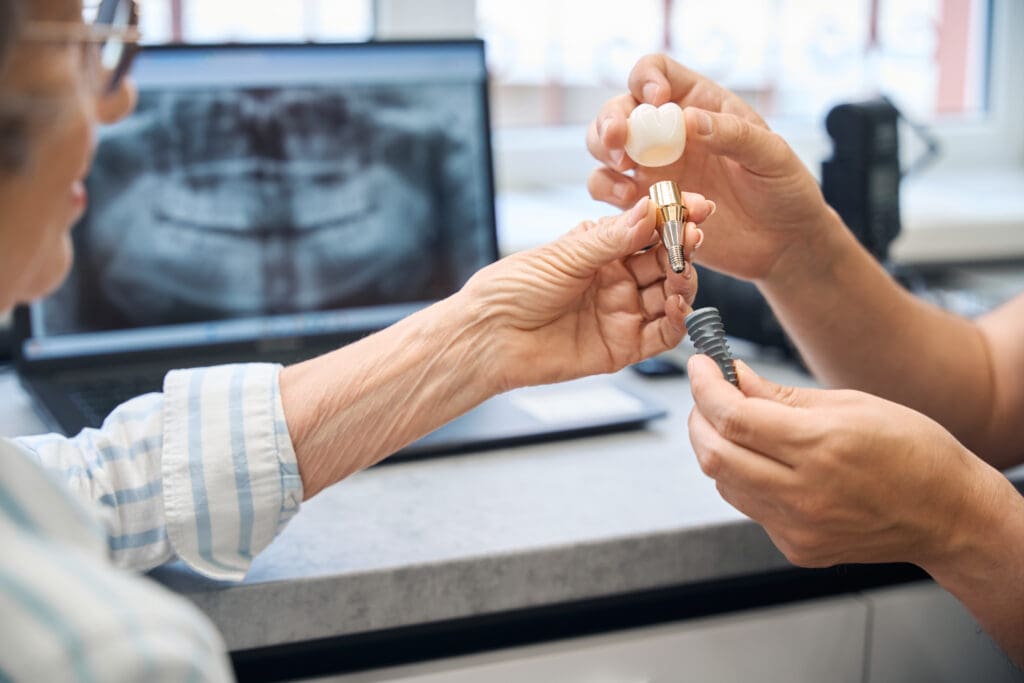
Do I Qualify for Dental Implants?
Implants are different from bridges and removable dentures. A traditional bridge needs the teeth next to the gap to be trimmed down. A denture rests on the gums and can move. A dental implant stands on its own. It protects nearby teeth and gives you a steady bite. Because the implant replaces the root, it also keeps your jawbone healthy.
Many patients in the Wayne, Main Line, and surrounding communities can get implants from Dr. Gartner. Qualifications include:
- Good gum health and enough bone are important. If the bone is thin, Dr. Gartner may recommend bone grafting or a sinus lift to build support. If you have gum issues, Dr. Gartner can provide periodontal therapy to prepare you for implants.
- You don’t use tobacco or are planning to quit. If you smoke, quitting helps improve healing.
- Conditions like diabetes should be under control before surgery.
Adults of many ages do well with implants. Dr. Gartner will review your health history and take 3D images to plan your care.
Types of Dental Implants in Wayne, PA
Dental implants are flexible. Dr. Gartner will help you choose the right type for your needs, budget, and timeline. Common types include:
- Single Tooth Implant: Replaces a missing tooth with an implant and a custom crown. It blends in with your smile and protects the teeth on each side.
- Implant-Supported Bridge: If you are missing several teeth in a row, two or more implants can hold a bridge. This avoids trimming healthy teeth and gives strong support.
- Implant-Supported Denture (Overdenture): A full denture that snaps onto 2-6 implants for better stability. It still comes out for cleaning, but is much steadier than a regular denture.
- Fixed Full-Arch Implants (All-on-4/All-on-X): A full set of teeth that is fixed to 4-6 implants per arch. This option doesn’t come out at home, letting you enjoy a firm bite. Many patients call this “teeth in a day” because a temporary set can be placed on the same day as surgery.
- Mini Dental Implants: Smaller posts are used in some cases to support a denture when the bone is thin. They may reduce healing time, but they aren’t right for everyone.
- Immediate Implants and Immediate Load: In select cases, the implant can be placed at the same time a tooth is removed. Sometimes a temporary tooth is placed right away. Dr. Gartner will decide if your bone and bite make this safe.
The Dental Implant Process at Strafford Dental
Your dental implant journey has clear steps. Your team will guide you from start to finish. Here is the general process:
- Consultation and Planning: You will meet with our implant dentist to discuss your goals, health, and budget. We will take digital X-rays or a 3D scan (CBCT) to measure your bone and map out nerves and sinuses. We will review options and give you a clear treatment plan, timeline, and cost estimate. We can also discuss insurance and financing options if needed.
- Pre-Treatment (If Needed): If you need a bone graft or sinus lift, these procedures are performed first to build support. A graft can be placed at the time a tooth is removed or later. Healing usually takes a few weeks to a few months, depending on the case.
- Implant Surgery: Implant placement is a routine, in-office procedure. Local anesthesia numbs the area. Many patients also choose sedation to relax. Dr. Gartner places the titanium post into the jawbone at a precise angle. If you’re getting a same-day temporary tooth or a temporary denture, he will adjust it for comfort before you go home.
- Healing and Osseointegration: Over the next 3-6 months, your bone fuses to the implant. This is what makes implants so strong. During this time, you can usually wear a temporary to fill the space. Most people have only mild soreness for a few days after surgery. Over-the-counter pain relief and a soft-food diet help. We will schedule checkups to watch your progress.
- Abutment and Impressions: Once the implant is stable, we attach the abutment. This connector links the implant to your new tooth or teeth. We will take digital scans or impressions to make your custom crown, bridge, or denture. We match shade and shape to your smile.
- Final Restoration and Bite Check: When your new teeth are ready, we secure them to the abutment(s). We will check your bite and make small tweaks so everything feels right. You will get simple home-care tips to keep your implants and gums healthy.
Most patients say implant surgery is easier than they expected. Dr. Gartner offers options like local anesthesia, oral sedation, or IV sedation when appropriate. Swelling and minor bruising can happen and usually improve in a few days. As with any surgery, there are risks such as infection or implant failure. But these are rare, especially with careful planning and good home care.
Why Choose Strafford Dental for Implants in Wayne, PA?
Choosing the right dentist for your dental implants is one of the most important decisions you’ll make. At Strafford Dental, we combine a legacy of community trust with advanced implant training to give you results you can count on.
- A Legacy of Trust in Wayne: Our practice has been caring for families in Wayne, Radnor, Devon, Berwyn, Malvern, Paoli, Villanova, and the greater Main Line for over 40 years. Dr. Eric Gartner grew up in this community and in this practice. He knows the expectations of Main Line patients and delivers the quality and aesthetics you deserve.
- Advanced Training and Precision: Dr. Gartner trained at the University of Pennsylvania School of Dental Medicine, one of the nation’s top dental schools. He uses 3D imaging and digital planning to place implants with precision, minimizing discomfort and maximizing success.
- Comprehensive Care Under One Roof: From your initial consultation and bone grafting to placing the implant and attaching your final crown, we handle it all right here in our Wayne office. No need to coordinate between multiple specialists.
- Patient-First, Not Insurance-First: We plan your treatment based on what’s best for your health and your smile, not what an insurance company dictates. We give you a clear plan and cost estimate before we start, so there are no surprises.
- Gentle, Comfortable Care: We know that even the word “surgery” can make people nervous. We offer sedation options, gentle numbing techniques, and a calm, unhurried environment to help you relax. You’re in good hands.